
FAQ
1. Understanding digital resilience and its challenges
What is digital resilience?
Digital resilience refers to an organization’s ability to continue operating, make decisions, and recover from various digital disruptions (cyberattacks, technical failures, dependency on suppliers, geopolitical tensions, or supply chain disruptions).
It therefore goes far beyond cybersecurity alone and is part of a broader logic of continuity and trust.
Why has digital resilience become a key issue?
Organizations now operate in an environment characterized by a significant increase in cyberattacks, a growing number of incidents affecting critical services, and increasing dependence on external providers and infrastructures.
These risks are compounded by legal and geopolitical uncertainties. Many dependencies remain poorly identified and insufficiently managed, weakening information systems and business operations.
2. Understanding the Digital Resilience Index (DRI)
What is the Digital Resilience Index (DRI)?
The Digital Resilience Index is a methodological standard designed to measure an organization’s digital dependencies and assess its overall resilience.
It provides a structured framework to analyze vulnerabilities and manage risks. It is neither a regulatory standard nor a simple compliance tool, but a strategic reference framework to support decision-making.
Why was the DRI launched?
The DRI was created to address a growing need among businesses and public actors : to have a concrete tool to measure and manage digital dependencies.
In a context marked by geopolitical tensions, increased cyber risks, and strong reliance on critical infrastructures, the DRI provides an operational response where digital sovereignty had previously remained largely a political objective
Who is the DRI for?
The DRI is designed for all organizations : large corporations, SMEs, public institutions, and technology providers.
Any organization seeking to better understand and manage its dependencies can benefit from it.
What types of dependencies does the DRI analyze?
The DRI covers multiple types of dependencies, including :
- economic and contractual dependencies
- cybersecurity and operational autonomy dependencies
- technological dependencies (infrastructures, AI models)
- governance and internal decision-making capabilities
What domains does the DRI cover?
The DRI adopts a multidimensional approach covering all key resilience factors of an information system, including :
- strategic, legal, and economic dimensions
- data and artificial intelligence
- operations and supply chain
- technologies and cybersecurity
- environmental impact
3. Purpose and benefits of the DRI
What is the DRI used for?
The DRI helps identify weaknesses in critical systems, measure risk exposure, and prioritize actions.
It is a management tool that enables organizations to structure their digital strategy and better control their dependencies.
By making dependencies visible and measurable, it allows a shift from intuitive to informed management.
Why is it considered a strategic tool for executives?
The DRI provides leaders with clear visibility into their digital dependencies and vulnerabilities.
It enables informed decision-making regarding investments, risk management, and technology choices, making it a strategic tool for executive committees and boards.
What are the benefits for an organization?
The DRI improves risk control, business continuity, and stakeholder trust.
It also enhances strategic visibility and can become a competitive advantage in an increasingly demanding environment.
Does the DRI aim to eliminate all dependencies?
No. Eliminating all dependencies is often unrealistic.
The DRI’s objective is to help organizations understand and manage interdependencies effectively, enabling pragmatic strategic autonomy based on informed choices.
4. Overall structure of the framework
A simple way to understand how the DRI works?
The DRI can be compared to :
- a driving handbook (open reference framework)
- and a driving test (official, controlled certification)
In this logic, an initial “guided learning” phase is implemented to support DRI advisors and their clients (temporary agreement).
How is the framework structured?
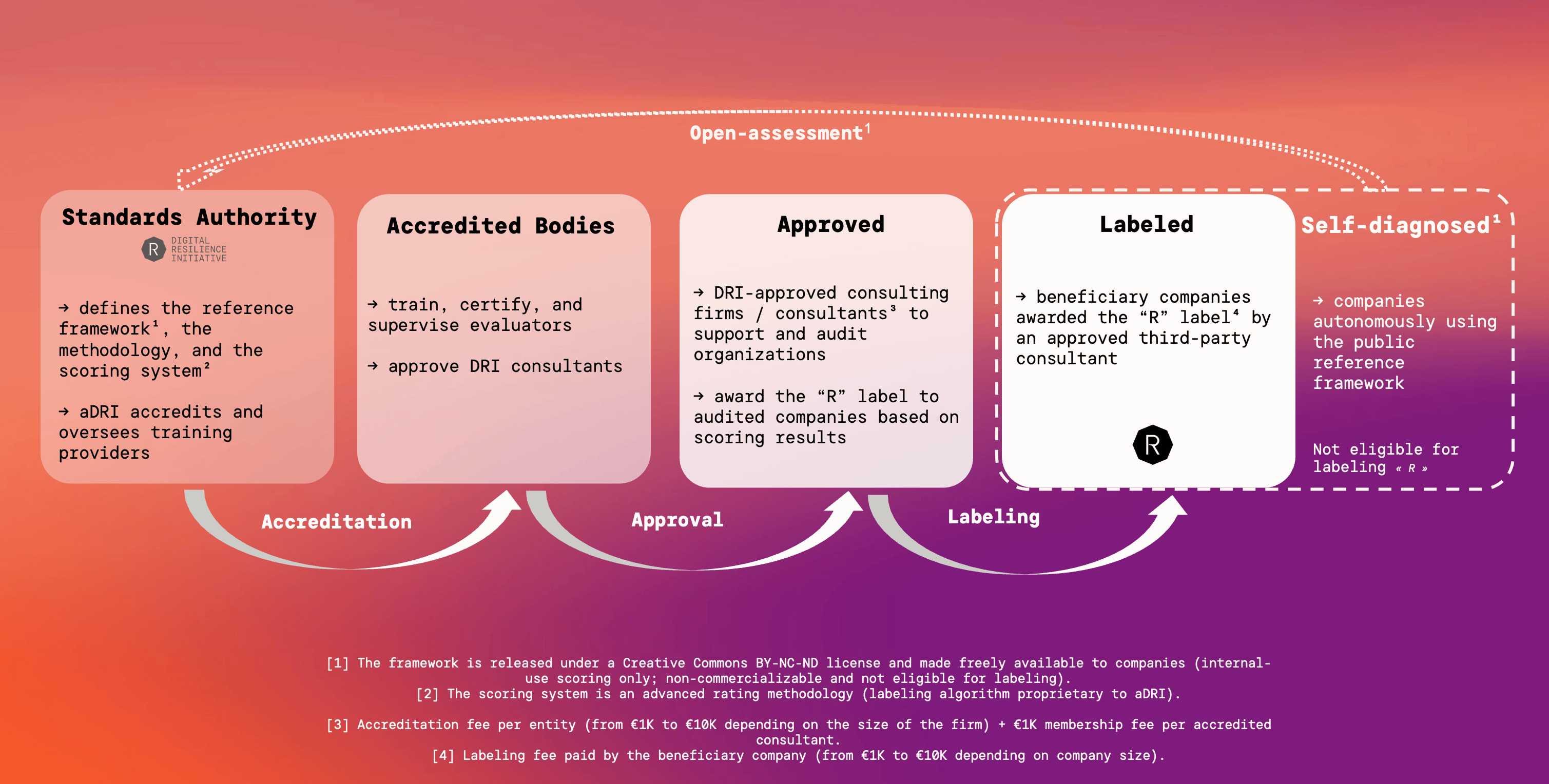
The system operates on three complementary levels :
- 1. Open level – dissemination and self-assessment
- 2. Controlled level (scoring) – ensures reliability
- 3. Certification level (labeling) – official recognition
What is the governance model?
Standard Authority (aDRI)
→ Defines the framework, methodology, and scoring rules
→ Accredits and supervises training actors
Accredited entities
→ Train, authorize, and supervise evaluators
→ Approve DRI consultants
Approved actors
→ Firms/consultants authorized to audit and evaluate
→ Deliver the “R” label
Labeled organizations
→ Companies officially certified through an approved third party
5. Access and usage conditions
Is the entire system freely accessible?
No. The framework distinguishes between :
- an open part, accessible to all
- a controlled part, restricted to aDRI and authorized actors
What does the open part include?
It includes :
- the reference framework
- the evaluation grid
- general methodological guidance
These resources allow organizations to understand requirements, structure internal reflection, and perform an initial self-assessment.
Can these resources be freely used?
Only within limits :
- allowed for internal use, training, and preliminary diagnostics
- not allowed for commercial services
- cannot be modified or reused commercially without authorization
6. Scoring, evaluation, and certification
Does self-assessment provide an official DRI score?
No. Self-assessment is indicative only and cannot produce an official score or benchmark organizations.
What is DRI scoring?
Scoring is the official calculation mechanism, based on :
- weighting rules
- aggregation models
- a proprietary algorithm
It ensures reliable results and enables certification.
Is scoring public?
No. It is proprietary and restricted to aDRI and approved actors.
Why is it not open?
To ensure robustness, comparability, and credibility.
Without strict control, inconsistent or unreliable results could undermine the system.
Who can issue an official DRI score?
Only aDRI or approved actors.
Can consulting services be offered based on the DRI?
Not freely. Any commercial use must be authorized through agreements or accreditation.
7. Operational process
How does a DRI assessment work?
It involves :
1. mapping critical systems and functions
2. analyzing dependencies
3. structured evaluation across resilience pillars
4. assigning a score and recommendations
How to start a DRI approach?
- define a relevant scope
- engage with trained experts
- build a roadmap
- optionally begin with self-assessment
Can an organization be certified?
Yes. Organizations can obtain certification or labeling based on the DRI, which can be used for external recognition.
8. Governance and ecosystem
Who initiated the DRI?
The DRI was initiated by three co-founders : David Djaïz, Yann Lechelle, and Arno Pons, within a broader ecosystem of public and private actors.
What is the role of public authorities?
They support the initiative by encouraging adoption, without imposing strict regulation.
What is the role of aDRI?
aDRI ensures the independence, neutrality, and robustness of the framework and organizes its deployment.
Why is this a collective initiative?
The DRI relies on collaboration between public institutions, companies, and experts to establish a credible and shared standard.
What is the role of consulting firms?
Approved consulting firms conduct assessments and support organizations in implementing the methodology.
9. Deployment and outlook
Where does the project stand today?
A first version of the framework is nearing completion (expected June 2026), with ongoing refinements.
What is happening in the current phase?
A transitional phase supports adoption without official scoring or certification.
What are the next steps?
An accreditation system will be deployed (from July 2026) to enable official evaluations and labeling.
What is the international ambition?
The DRI aims to become a European and global reference standard.
What is the core principle of the framework?
The DRI balances :
- openness (broad dissemination)
- rigor (controlled scoring and certification)